
Once a Stud, Always a Stud: How a 70-Year-Old Team Became Baseball’s Most Enduring Brotherhood
⋅ Affiliates
WICHITA, Kansas — Every July, as the sun beats down on Eck Stadium and the crack of wooden bats echoes across the Kansas plains, a familiar sight emerges from the visitor’s dugout. The Seattle Cheney Studs, in their classic pinstripes or in their familiar blacks, take the field for yet another appearance at the National Baseball Congress World Series. Since 2002, they’ve missed the tournament only once—in 2020, when the pandemic silenced ballparks across America.
But what makes the Studs different from the hundreds of other amateur teams that have cycled through Wichita over the decades isn’t just their consistency. It’s the culture they’ve built—a culture that has now produced four National Baseball Congress Hall of Famers and created a community where players return year after year, long after their professional dreams have faded.
“The NBC was a special place for us,” says Garrett Breda, the team’s former catcher who was inducted into the NBC Hall of Fame in 2026. “Only relatives and girlfriends would come to games in Seattle, but we have a great following in Wichita.”
That following, a dedicated group of Studs supporters known as the “Circle of Love”, represents something deeper than typical fandom. They’re part of a story that stretches back seven decades, to a lumber magnate’s dream of fielding his own baseball team.
The Foundation: Ben Cheney’s Vision
In 1954, when Ben Bradbury Cheney founded the team that would bear his company’s name, he couldn’t have imagined his creation would become one of amateur baseball’s most storied franchises. The “Studs” nickname came from Cheney Lumber Company’s specialty—the 2×4 studs used to build homes and structures across the Pacific Northwest. For a handful of years, Cheney himself played as an infielder for his own team.
The team would remain in the Cheney family’s orbit for generations. In 2019, Ben’s grandson Henry Cheney hit .429 and scored the winning run in the championship game, earning tournament MVP honors. It was a Hollywood moment—three generations of Cheneys united by pinstripes and a love of the game.
But by then, the team’s identity had evolved beyond the founding family. The Studs had become something else entirely: a refuge for players who simply couldn’t quit baseball.
The Culture Builder: Barry Aden
On a summer day in the early-1970s, 10-year-old Barry Aden wandered through a sports complex in Burien, Washington, looking for his teenage brother’s game. Peering through a chain-link fence, he spotted a team that caught his eye. Someone handed him a sweaty helmet and invited him to be the bat boy for the Cheney Studs.
He was hooked.
Decades later, Aden would become the architect of the modern Studs dynasty. A standout pitcher who threw three no-hitters and won 100 games for the team from 1980 to 1993, Aden took over as manager of the Seattle Studs in 1990. Over the next three decades—through stints with the Tacoma Timbers and Seattle Cruisers and the Studs again—he would build something rare in amateur sports: continuity.
His philosophy was simple but revolutionary: trust your players.
“Barry is the definition of a player’s coach,” Breda explains. “He’s not a coach that’s gonna be yelling at you. He has a cool calm demeanor. He never gave us signs at third base and never called pitches. He trusted us and just let us play.”
That trust extended beyond the field. Aden created an environment where players felt valued not just for their talent, but for who they were. The result was remarkable loyalty. Players would return summer after summer, even as their careers took them elsewhere.
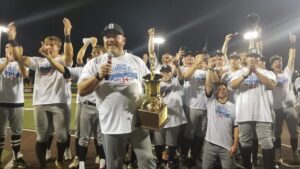
When Aden returned to lead the newly christened Seattle Cheney Studs in 2001, he transformed them into a powerhouse, accumulating over 1,200 wins and more than 27 NBC World Series appearances, with 100 wins in Wichita alone. With the Studs specifically, he’s led them to 28 NBC World Series appearances with 15 top-five finishes. They reached the championship game in 2008, 2010 and 2012 before finally breaking through in 2013. Two more titles followed in 2015 and 2019.
But perhaps Aden’s greatest achievement is what he built off the field: a brotherhood that transcends the game itself.
The Players Who Couldn’t Leave
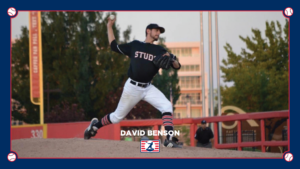
David Benson first put on a Studs uniform in 2008. He wouldn’t take it off for 12 years.
A pitcher who made 20 appearances in Wichita between 2008 and 2019, Benson became one of the most dominant hurlers in modern NBC World Series history. His 10-3 record and 2.85 ERA might be impressive on their own, but what sets Benson apart are the records: most decisions, most starts, and most innings pitched in the NBC’s modern wood bat era.
He was there for all three championship runs—2013, 2015, and 2019. In the 2013 title game, he threw a complete-game four-hitter, leading the Studs to their breakthrough championship. Benson was named tournament MVP.
What makes Benson’s story remarkable isn’t just his dominance. It’s his longevity. For 12 summers, while building a career elsewhere, Benson kept returning to the Studs. The team became so much a part of his life that he joked at his NBC Hall of Fame induction in 2025 that even his honeymoon was spent at Lawrence-Dumont Stadium.
Taylor Thompson’s path was similar—he never chased the professional dream. Instead, he became a Seattle legend in his own right.
A soft-tossing reliever who relied heavily on his 65 mph breaking ball, and whose fastball topped out in the 80s, Thompson relied on control and a devastating breaking ball to keep hitters off-balance. In a program that featured more than 100 former and current professionals, Thompson carved out his own unique place. For 11 years, he was a staple of the Studs’ success, a strikeout machine despite his unconventional velocity.
“He’s been amazing for us,” Barry Aden said in 2014. “He’s Hall of Fame good for us. He’s a strikeout machine, even though he throws 65 mph.”
Thompson, married with a full-time job in Sedro Wooley, Washington, kept returning for the same reason so many others did: the chase for championships and the bonds with teammates. He was there for the heartbreak years—the runner-up finishes in 2008, 2010, 2012, and 2014—and for the glory of 2013 and 2015.
In the 2015 championship game, Thompson picked up the save as the Studs beat the Haysville Aviators 5-2, retiring the final three hitters who all represented the tying run. His close friend Breda singled and scored, just as he had in the 2013 title game. Thompson surpassed 100 career NBC World Series innings that year, a milestone few pitchers ever reach.
“It’s always more fun when you win a lot,” Thompson said. “It’s just a really good situation for me with a good group of guys. It works for me and I hope that it’s been working for them.”
“We actually had a lot of confidence going into both of those championship games because of our starting pitchers,” Breda recalls. “But entering the 2015 game I think it felt less pressure since we had already won one.”
Thompson was inducted into the NBC Hall of Fame in 2016, joining his manager Aden who was inducted in 2011. When Benson was inducted in 2025, and Breda in 2026, it marked an extraordinary achievement: four Hall of Famers from the same team, all overlapping during the Studs’ golden era.
The Captain
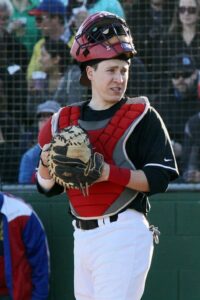
Garrett Breda wasn’t supposed to be a catcher. He played second base through his teenage years before gradually transitioning behind the plate. It wasn’t until his senior year of high school that he became a full-time catcher.
Small for his age growing up, Breda’s coaches would have him lay down sacrifice bunts to move runners over. He took pride in perfecting the craft, carrying it with him to Everett Community College and eventually to the Studs.
A teammate’s connection got him a tryout in 2007. One of the Studs coaches, Steve Potter, recognized Breda’s last name—he’d once played flag football with Breda’s father. After impressing at the tryout, Breda joined the team as a freshman. Barry Aden assigned him to bullpen catching duties that first year, telling him to observe and learn.
What Breda learned was that the Studs were different.
“Playing with the Studs was so much fun, and I looked forward to it each year,” he says. “We had a lot of the same guys every summer and I enjoyed playing with them.”
From 2008 through 2018, Breda appeared in 52 NBC World Series games. He hit just .188, but his value wasn’t measured in batting average. Breda threw out 27 of 70 would-be base stealers, a 38.5% caught-stealing rate that kept opponents honest. In 2010, he led the tournament with seven runners caught stealing.
But it was those sacrifice bunts that became his signature. Eighteen times in tournament play, Breda laid down a bunt to advance a runner—an all-time NBC World Series record that still stands. He recorded at least one sacrifice in all but one of his 11 tournaments.
“I never hit a bunch of home runs in my life,” Breda admits. His lone NBC home run came in 2018, his final season. “It was one of those home runs that you hit so well you barely feel the ball come off your bat. When I hit it, I knew it was gone.”
That final year was also his best offensive tournament. He hit .462 with that home run, putting together the kind of performance that earned him his second All-American award. In his last two games—both elimination contests—Breda collected five hits.
His final game as a player came against the Seattle Studs’ biggest rival: the Santa Barbara Foresters, who had beaten them in three of their four championship losses. With their season on the line, Breda had three hits and threw out a runner attempting to steal in a 5-0 victory. Two nights later, his career ended with two hits in a quarterfinal loss.
After the 2018 season, the Seattle Studs retired Breda’s number 2 in a ceremony at the start of the 2019 campaign. His teammates called him “The Captain,” a title that reflected not just his position behind the plate but his role as the team’s heartbeat.
What Draws Them Back
After college, Breda entered his family’s real estate business. But before settling into his career, he spent one summer with the McAllen Thunder in south Texas.
“That was my taste of professional baseball getting paid $600 a month and playing in 110-degree heat every day,” he says. “It was a cool experience but after that, my playing days were just with the Studs.”
The same pattern repeated across the roster. Players would chase professional dreams, reaching various levels of success. Some, like Tim Lincecum, would make the major leagues. Others would spend years in the minors before accepting that baseball wouldn’t be their career.
But they kept coming back to the Studs.
Part of the appeal was the competition. The Studs dominated the Pacific International League, winning the championship 23 times as of 2025 under Aden’s leadership across his various teams. They won the Kamloops International Tournament 13 times and the Grand Forks International six times in that same time.
But the real draw was simpler: the Studs had become family.
“The NBC was such a first-class experience, and with how well it drew fans showed how big of a tournament it was,” Breda explains. “To play in and win the NBC was our most important goal each year.”
The 2013 Breakthrough
By 2013, the frustration was mounting. The Studs had reached the championship game in 2008, 2010, and 2012, finishing with a 6-2 record each time. They’d come so close, so often, that doubt began creeping in.
“The tournament always had so many good teams and it was extremely hard to even make it to the finals,” Breda recalls. “Doing it three times before, it felt like we may never actually win it.”
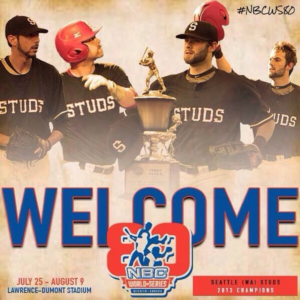
That year, everything aligned. The Studs went undefeated through the tournament, their chemistry perfect. In the championship game against the Wellington Heat, Benson threw his complete-game gem while Breda singled and scored. They won 5-1.
“It felt like a big weight off our shoulders,” Breda says. “So when we did, it was such a big relief.”
Two years later, they were back in the championship game against the Haysville Aviators. This time, there was less pressure. Breda had his hit and scored again, added one of his trademark sacrifice bunts, and watched his friend Thompson close out the 5-2 victory.
The 2019 championship—with Henry Cheney scoring the winning run—completed the circle. Three titles in seven years, all with largely the same core of players who had endured those heartbreaking runner-up finishes.
A Different Kind of Success
In 2016, the Studs faced the Kansas Stars, a team comprised of former major leaguers. Jeremy Guthrie, the Stars’ starting pitcher, still had one more MLB appearance in his future. Adam LaRoche was in the lineup. The Stars won easily.
But Breda remembers it fondly.
“We were 3-0 when we played the Stars in an elimination round,” he says. “That was our most talented team. It was awesome playing before a sold-out crowd. We weren’t expected to win. I enjoyed having conversations with these All-Stars as a catcher when they would come to bat.”
The contrast was stark. These were men who had reached the pinnacle of baseball, earning millions and playing in packed stadiums across America. The Studs players held regular jobs and paid their own way to tournaments.
But for two hours on a summer night in Wichita, they shared the same field.
“You could tell the difference even if they had been away from the game for a while,” Breda continues. “I remember Adam LaRoche hit a moonshot over the river off our really good pitcher. I thought he should still be playing in the major leagues.”
That game encapsulated what makes the Studs special. They weren’t trying to prove they belonged in the big leagues. Most had long ago made peace with where their careers had led. They were there because they loved baseball and loved each other.
The Legacy
Today, the Seattle Cheney Studs are the third-oldest team eligible to participate in the National Baseball Congress World Series. They’ve been active for 70 consecutive years, competing under various iterations—Cheney Studs, Performance Radiator Studs, and now Seattle Cheney Studs.
Barry Aden, now inducted into five Halls of Fame including the National Baseball Congress (2011), continues to lead the team alongside his sons Tegan and Cody.
The team motto remains simple: “Once a Stud, Always a Stud.”
It’s more than marketing. It’s a promise that once you put on the pinstripes, you’re part of something that endures. You’re part of a lineage that connects a lumber magnate playing infield in 1954 to his grandson scoring the winning run in 2019. You’re part of a brotherhood that produces Hall of Famers not because they were the most talented, but because they showed up, year after year, perfecting their craft and caring for each other.
In an era when sports culture often celebrates individual achievement and professional advancement above all else, the Studs offer something different: a reminder that success can be measured in summers spent together, in championships won with your closest friends, in sacrifice bunts that move the runner over.
Garrett Breda played 447 games for the Studs over 12 summers, hitting .250 with 10 home runs and 185 RBIs. He set an all-time record with 18 sacrifice bunts in World Series play. His number hangs retired at home games.
But more importantly, he found a place where he belonged.
“Being with teammates in the same place for two weeks was special,” he reflects. “To play in and win the NBC was our most important goal each year.”
For 70 years, the Seattle Cheney Studs have been showing players that sometimes the best baseball stories aren’t about making it to the show. Sometimes they’re about finding your people, putting on the uniform one more summer, and playing the game you love with everything you have.
Once a Stud, always a Stud.
And now, four of them are Hall of Famers.