
The Man Who Stayed: Mark Standiford’s Lifetime in Kansas Baseball
⋅ History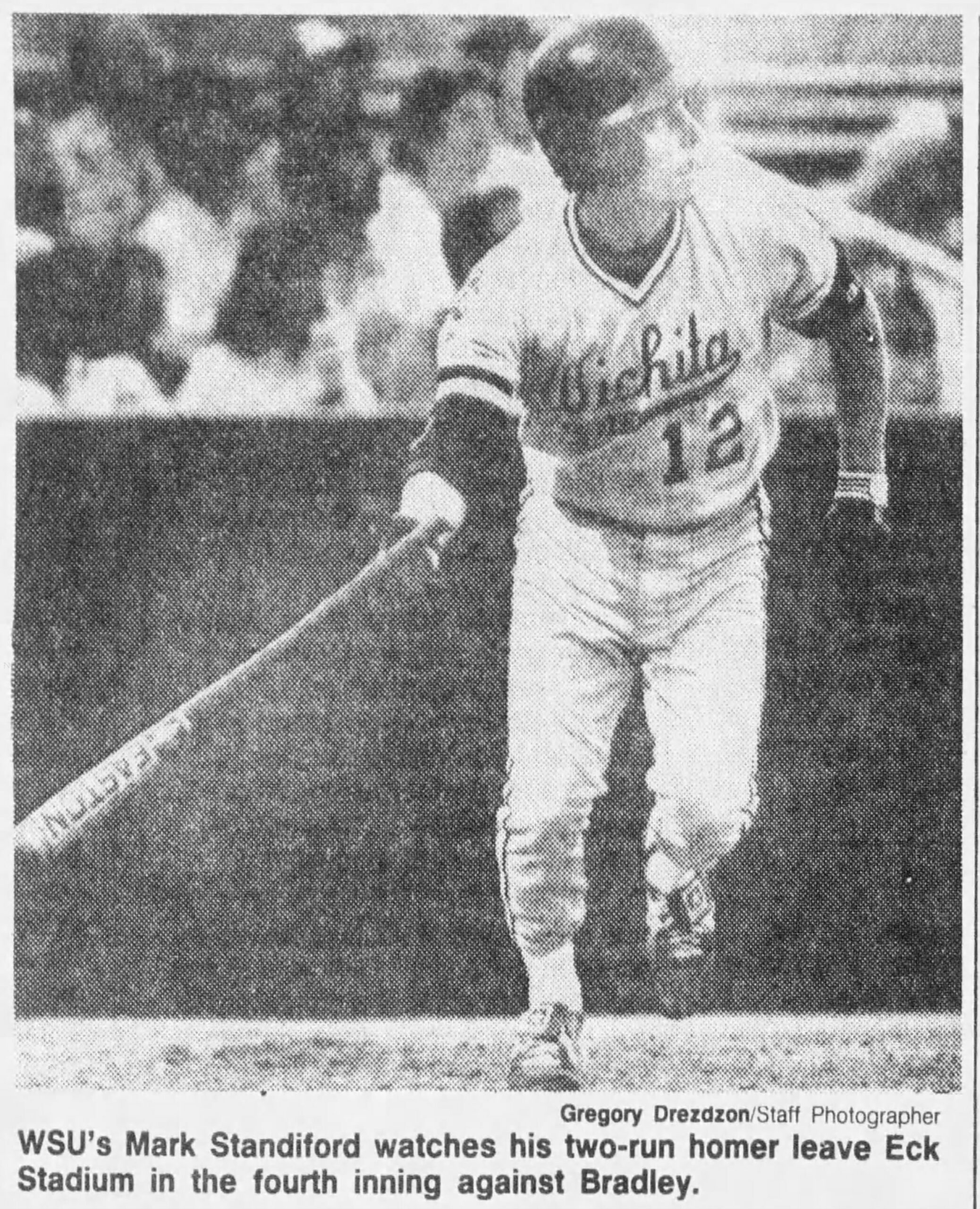
How a 5’7″ catcher from Wichita became one of Kansas baseball’s most enduring figures
Mark Standiford was seven years old when he first fell in love with Lawrence Stadium. It was the early 1970s, and he was a bat boy for his brother Mike’s team during the NBC Kansas state tournament—a time when even Harry Caray would fly into Wichita to call the state championship game. The stands were packed, the scouts were everywhere, and for a kid growing up in Kansas, it felt like the center of the baseball universe.
“When I was growing up, it was the place to be in the summer with the great teams and scouts that were there,” Standiford remembers. “It was a great atmosphere.”
That atmosphere would define his life. More than 50 years later, Standiford remains precisely where he started: embedded in Kansas baseball, now as head coach at Tabor College in Hillsboro, about an hour north of Wichita. His induction this month into the National Baseball Congress Hall of Fame caps a career that never sought the spotlight of the major leagues but instead illuminated every corner of Kansas’s rich baseball landscape.
Small frame, big ambitions
At 5’7″ and 160 pounds, Standiford wasn’t the prototype college prospect. But what he lacked in size, he made up for in production. As a high school multi-sport star in Wichita, he earned first-team all-city honors in baseball as a catcher all four years, plus football accolades as a running back and then as a quarterback. Baseball scholarship offers outnumbered football, and when Wichita State came calling with a full ride—contingent on moving to second base—the decision was easy.
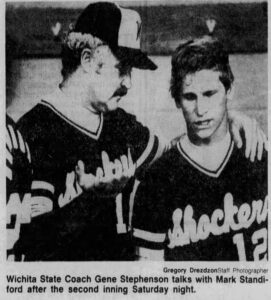
His goal ultimately became wanting to play for the Shockers, and in the mid-1980s, that meant joining one of college baseball’s emerging powerhouses. Gene Stephenson had taken over the Wichita State program in 1978 and quickly transformed the Shockers into a national contender. By the time Standiford arrived in 1984, the program had already been to the 1982 College World Series finals, where they lost to Miami after setting the NCAA record with 73 wins in a single season, and the new Eck Stadium, which opened in 1984, was packed nightly as Wichita embraced both the Shockers and the NBC World Series happening downtown each summer.
Standiford’s timing was perfect. He anchored the Shocker lineup from 1985 to 1988, hitting .355 with 16 home runs as a freshman and earning second-team Freshman All-American honors. His senior year in 1988, he led Wichita State back to Omaha for another College World Series appearance, hitting .563 in the tournament, homering in his final collegiate at-bat, and earning All-Tournament honors. Those 28 home runs that season and 69 career long balls remain school records today—cementing him as what the university calls “the most prolific power hitter in Shocker history.”
Alaska and a national championship
But Standiford’s summers belonged to the NBC World Series. After hitting .355 with 16 home runs at Wichita State and going 2-for-3 with a double, two runs scored, two driven in, and a stolen base in his first NBC tournament appearance with the Wichita Broncos in 1985, he caught the attention of Anchorage Glacier Pilots manager Steve McFarland. The Alaska Baseball League was considered the premier summer circuit in the country at the time, and McFarland wanted Standiford up north.
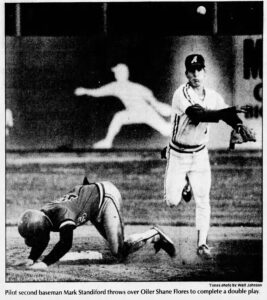
The 1986 season became the stuff of legend. Standiford hit 12 home runs during the Alaska League regular season and finished second in MVP voting as the Pilots won the league title. Then they traveled to Wichita for the NBC World Series. After an early loss, they clawed through the losers’ bracket and took home the national championship, with Standiford scoring twice in the final against the Grand Rapids Sullivans.
“We won the Alaska League which was a big deal, and then we came down to the NBC and lost early, but then came through the losers bracket,” Standiford recalled. “It was a great summer to be able to win it all, and as a local kid to do so in front of my home fans and friends was special. The Alaska League was the top league at the time so it meant a lot to win them both.”
He returned to the Pilots in 1987 and was named to the All-Alaska team for the second straight year as Anchorage’s roster swelled with even more future big leaguers, including Ben McDonald and Russ Springer. Despite that depth, the Pilots could not duplicate the prior year’s success in Wichita, finishing 2-2 in the tournament. Standiford took a different lesson from that summer, one that would serve him throughout his coaching career: “The team chemistry matters more than the talent. The ’86 team was one of the funnest teams I’ve played on.”
The road not taken
The San Francisco Giants drafted Standiford on the eve of the 1988 College World Series, and he spent a few seasons in their farm system. “It was tough,” he said. “I was older. You kind of see the writing on the wall and have to make tough decisions.” After making the All-Star team for a High-A club his second year, he was shipped to the Midwest League. It didn’t feel like progress, so he finished the season and walked away. “I enjoyed the experience and I’m glad I did it, but it didn’t quite work out.”
Many players in that position disappear from baseball entirely. Standiford did the opposite—he returned to Wichita, opened his own baseball academy, and started coaching while continuing to play in NBC tournaments with WSU alumni teams and other local squads. His 1996 summer with the WSU Sluggers—a collection of former teammates fresh out of pro ball or college—stood out, as he hit over .300 and the team reached the semifinals before losing to the eventual champion El Dorado Broncos.
“We were all just out of pro ball or college and we didn’t practice much, we just showed up to play, and to have that much success was a great memory,” Standiford said. “We were good friends with each other, having grown up together.”
Making history at the NBC
The 2003 NBC World Series presented a challenge no one had faced before or since. Standiford managed two teams: the Wichita Braves, a competitive squad he’d coached from high school into college, and his academy’s 18-and-under Wichita Sluggers. Both teams qualified for the tournament—the first and still only time in NBC history that one manager has led two entries in the same World Series. The Braves advanced to the semifinals before losing to the Santa Barbara Foresters, a team that would launch a dynasty by winning a record 10 NBC championships in the years that followed. The Sluggers went 0-2, so the teams never faced each other on the field.
“Managing two teams [in the NBC] was tough,” Standiford admitted. “I was lucky to have some great coaches to help me out. It was time consuming that summer for sure.” Over more than a decade, Standiford appeared as a manager in the NBC almost annually, finishing with a 23-22 record across 11 teams in 10 tournaments and two top-five finishes. His final NBC appearance came fittingly at the helm of a Kansas collegiate alumni team in 2011, by which time he had already found his permanent home.
In total, Standiford’s NBC World Series ledger is as deep as it is unique. As a player, he appeared in eight tournaments, hitting .265 (30-for-113) with three home runs, eight doubles, a triple, 27 runs scored, and 20 runs batted in. As a manager, he guided teams in 10 World Series (11 total entries), going 23-22 with two top-five finishes. That combination of longevity and versatility is rare even in the NBC’s long history.
Building Tabor into a power
Tabor College is a small Mennonite school in Hillsboro, Kansas, located about 50 miles north of Wichita, with a few hundred students on its main campus. It competes in the NAIA, far from the Division I spotlight that Standiford knew as a player, but over 17 seasons he has built something substantial. Since taking over in 2008, Standiford has led Tabor to multiple program records and, over his tenure, compiled an overall record of 642-287-1, good for a .691 winning percentage through the end of the 2025 season.
Under his leadership, the Bluejays have reached two NAIA World Series, won five Kansas Collegiate Athletic Conference regular-season titles, and made eight postseason appearances. Along the way, his teams have set school marks in categories ranging from wins and runs to hits, batting average, and home runs, and he has helped send more than 100 players on to college baseball opportunities over his broader coaching career. For a small Kansas program, that kind of sustained excellence stands out.
The work is different from managing NBC teams each summer or hitting home runs at Eck Stadium, but the foundation is the same: fundamentals, chemistry, and a deep understanding that baseball in Kansas means something. The NBC World Series, founded in 1935 by Hap Dumont, has produced hundreds of major leaguers since its inception—from Satchel Paige to Roger Clemens to Albert Pujols. Standiford knows that tradition because he lived it, from bat boy to player to manager to coach.
The rare constant
The baseball landscape Standiford grew up in has changed dramatically. Wichita hosted the College World Series once, in 1949, before the tournament moved permanently to Omaha the following year. Lawrence–Dumont Stadium, the NBC’s home for decades and renamed in honor of Hap Dumont in 1978, was demolished in 2019 to make way for a modern downtown ballpark. Today, the NBC World Series plays under the lights at both Wichita State University and the new downtown ballpark at Riverfront Stadium, continuing a summer tradition in a new setting.
But some things endure. The NBC World Series still runs every summer. Wichita State still plays at Eck Stadium, where the program maintains one of the highest winning percentages in NCAA Division I baseball history and where Standiford’s 69 career home runs and 28 single-season homers still top the record books. And Mark Standiford is still teaching the game in Kansas, now to the next generation of Tabor Bluejays.
“I was able to still turn it into a baseball life,” Standiford said of his career.
That understates it. Over eight NBC tournaments as a player and 10 more as a manager—spanning from 1985 to 2011—Standiford participated in 18 different NBC World Series, threading through decades of Kansas baseball history. Add his four years starring at Wichita State during a golden era of the program, plus 17 years and counting building Tabor into a consistent winner, and you have something rare: a complete baseball life contained within the borders of a single state.
The Kansas Baseball Hall of Fame and Wichita State Sports Hall of Fame already recognized this, enshrining him as one of the program’s and state’s defining figures. Now, with his induction into the NBC Hall of Fame, Standiford joins the lineage of the tournament that first captured his imagination as a seven-year-old bat boy. He never made it to the major leagues, but he also never left home. For Kansas baseball, that’s turned out to be enough—and then some.