
Hap Dumont’s Legacy
⋅ NBC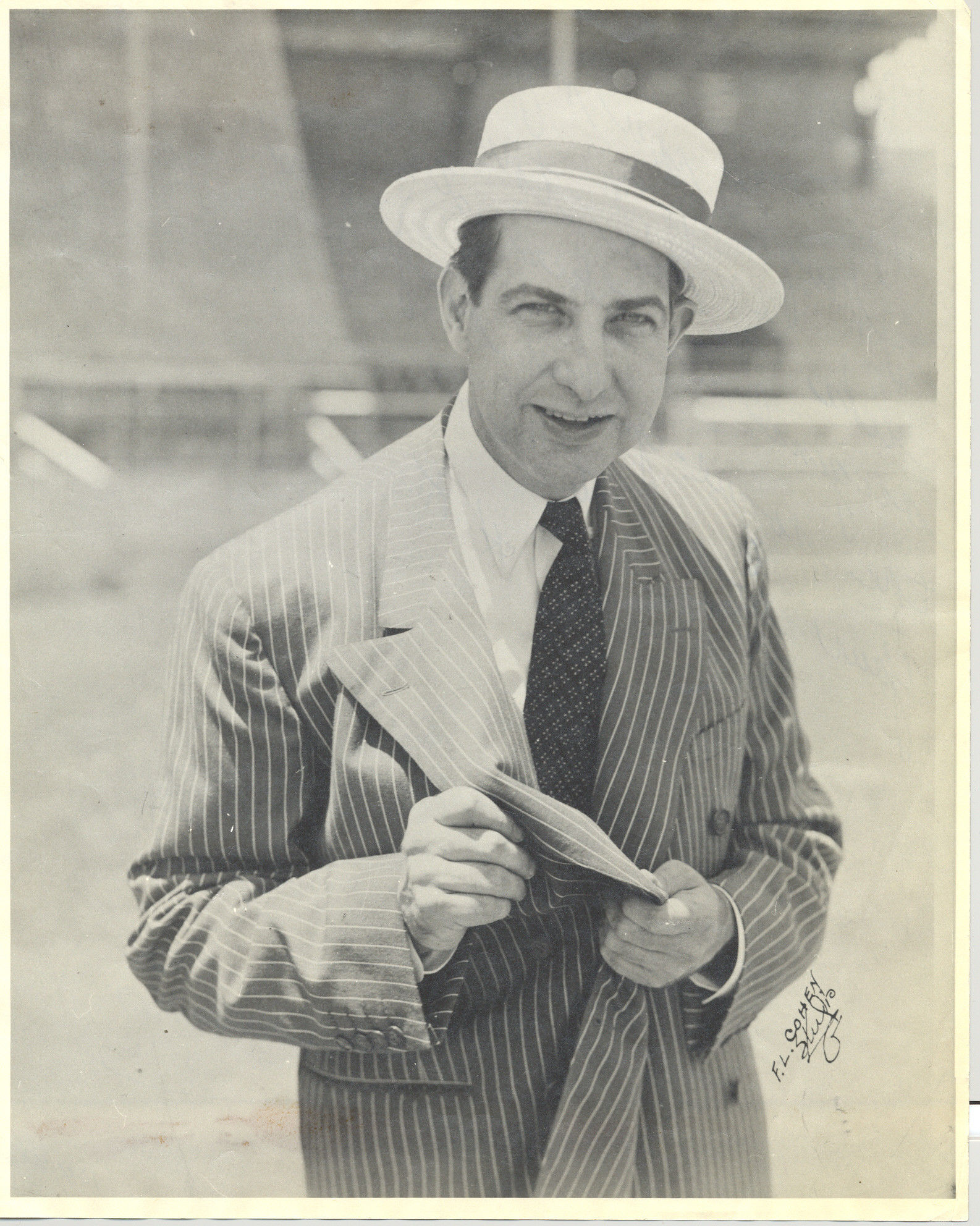
Originally Published in the 2014 NBC World Series Tournament Program
For 80 years, the National Baseball Congress World Series has been calling Wichita, KS home. This series has embedded itself in the hearts of long-time baseball fans, some of which have been coming to Lawrence-Dumont Stadium from the time they were born. We know the huge impact that the NBC founder, Raymond Dumont, had on this city, and on baseball, but what do we really know about the man in the hat? It has been 80 years since the NBC came to be, a legacy Dumont created, that does not plan to leave its home anytime soon.
Cigar chewing Ray was a Wichita native, growing up within its neighborhoods and attending what is now East High School. Well-liked and eccentric, he earned the nickname Happy, Hap for short, a name that stuck with him the rest of his life. Hap was always on the run while in school. He was on the debate team, ran two early morning paper routes for The Eagle, and in the evenings, he posted sports bulletins and answered the sports desk phone for the paper. Despite this, he graduated high school as valedictorian in 1923. These were early indications of just how motivated he would grow to be.
After graduation, Hap dabbled in different hobbies and careers. He left Wichita and headed for Chicago, Illinois where he tried his hand in stand-up comedy. Hap’s comedy career was ultimately a bust after he couldn’t book shows in English-speaking locations. Later, he made his way to Topeka to announce wrestling matches. Once, while on a visit to The Hutchinson News to promote some of the matches, he learned of an opening within their sports section. He left his job in Topeka and started working nights on the sports section for Hutchinson and during the days worked at Goldsmith’s, an office supply store, which needed someone to help sell and promote their new sporting goods section. It was during his time working for The Hutchinson News that he fell in love with a young coworker named, Gladys. They were happily married by 1927.
Throughout the next few years, Hap focused on promoting Goldsmith’s and working the sports desk in Hutchinson. Since Hap was so business-savvy, he had succeeded in making Goldsmith’s the place to go for sporting goods. One night during a shift at The Hutchinson News, a promoter from the traveling Sparks Brothers Circus came in asking if someone could help put together a Sunday baseball game between their clowns and some Wichita locals. Hap took it amongst himself to put this event together. He rented out Island Park Stadium, and watched as people rolled in to watch clowns play a team of firemen. This game was a success, and was the spark that ignited the fire that is now the National Baseball Congress.
In the next few years, Hap would start a semi-pro tournament situated in Wichita. The series was held on Ackerman Island, home to Island Park Stadium, situated on a sandbar in the river. It was a popular destination, until it burned to the ground after the 1933 championship game. This was when Hap’s crazy tournament idea blossomed. He went to the mayor of Wichita and convinced him that he would bring teams from all over for a national tournament if he could have a new stadium built. He promised to turn a profit and supply jobs for people during the Great Depression, ultimately convincing Mayor Charles Lawrence of the project. In his honor, the ballpark was to be named Lawrence Stadium.
Hap’s life drastically changed when tragedy struck in 1934. While Lawrence Stadium was still being built Hap was to go on a trip to Chicago for a national sporting goods convention. Before leaving, his wife Gladys noticed a small pimple on her nose. It became infected but doctors assured them that it was nothing serious. Thinking that everything would be fine, Hap left for his Chicago trip. Within days Gladys’s infection had become deadly, and a storm had hit the country making communication and travel nearly impossible. Radio stations sent out messages to Hap, newspapers put out letters to him telling him that his wife was dying. Upon hearing the news Hap started to head home, only realizing that he had lost the race home when he read a small paragraph in the K.C. News stating that his beloved wife had succumbed to the infection. Following her death, Hap threw himself into his work with the support of Gladys’s family.
It was 1935 and Hap needed to find a way to draw crowds and teams to Wichita for a national tournament. While racism was strong in the United States, Hap was color-blind and knew that to draw crowds he had to get the rumored best pitcher around, Satchel Paige. Years before the color barrier in the MLB was broken, Hap managed to convince Satchel’s team, the Bismarck Churchills to make a trip out to Kansas, along with an all Japanese team from Stockton, CA, another inter-racial team from Centennial, Texas, and a few other racially-ethnic teams from around the country. Bismarck won the championship, and Satchel Paige set a win and strikeout record that still stands today.
In the upcoming decades, Hap managed to keep the NBC running. Year in and year out, he brought teams from all 50 states and 28 different countries. It never mattered to Hap where someone was from or what they looked like; he just wanted to bring great baseball to Wichita and maybe make some money in the process. A few years after the death of his Gladys, he married again, to Annie. She understood the importance of this tournament, and kept him balanced within both parts of his world – the NBC and his personal life.
Hap was known as a determined yet absent-minded man. He worked year round to make the NBC World Series a success and never failed to pay a bill when it was due. If a friend needed help financially, he would throw some money their way. He would drive somewhere like the post-office and forget where he parked his car, prompting him to call the police on more than one occasion thinking that it had been stolen. His forgetfulness convinced his wife that she should be his personal chauffeur because he had an affinity of not paying attention when he was behind the wheel. He loved dogs, but never had one of his own. And he would chew on his cigars until they were soggy and droopy. These traits made him beloved to all who knew him.
Years of trying to promote the NBC brought some strange ideas to Wichita. Before the stadium had lights, Hap tried to paint balls and uniforms neon orange so that baseball could be played at night – this idea was ultimately a fail. He had a microphone that would pop out of the ground at home plate so umpires could read starting lineups, and catch the occasional argument between players or coaches. There was an automatic plate duster that would shoot out air, instead of the umpire having to bend down to clean the plate. And let’s not forget our beloved goose on the scoreboard, still laying down goose eggs for the visiting team to this day.
Hap spent most of his time at Lawrence Stadium. So although it was a surprise when he passed away in July of 1971, it was no surprise that he had been found in his office. That year we lost a man who had poured his heart and soul into the NBC, and in 1978 the stadium was renamed Lawrence-Dumont Stadium in his honor. Although we may not have Hap today, his spirit lingers in this stadium and in this tournament. This year we celebrate the 80th NBC World Series, and we celebrate the man who has brought us all here to Wichita so that we can all watch and play baseball together. Thank you, Hap.