
NBC Hall of Famer John Olerud
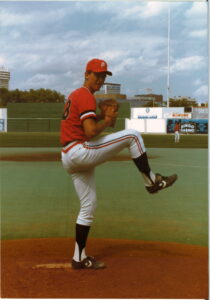
Baseball fans are glued to their seats anytime Shohei Ohtani is on the mound or standing in the batters box, as they know that in those moments, he may do something special that they’ll remember for a lifetime. Years before Ohtani was born, John Olerud had fans glued to their seats and metal bleachers at Lawrence-Dumont Stadium on an August night in 1998 watching a performance that would rival Ohtani today.
John Olerud’s baseball roots go back to his father, John Sr., who was a catcher in the 1960s. His dad attended Washington State University (WSU), and spent a few of those summers with teams that would play in the NBC national tournament. He finished fifth with the Everett Orioles in 1963, and third with the Bellingham Bells in 1964 with the extra play and experience certainly contributing to the confidence he had in 1965 for WSU when he was named Captain for the Cougars. That season he led WSU in almost every offensive category including a .336 average as they made it to the College World Series (CWS). Olerud Sr. efforts earned him All-American honors, and he was drafted by the California Angels. He then spent parts of seven seasons in the minors before deciding to pursue a career in medicine.
His son, following in his footsteps, would not stop at just the minor leagues. When he was selected as the 1990 NBC Graduate of the Year, Olerud said, “I’ve really had a lot of good things happen to me, Having my dad as my first coach and working with me gave me good foundation. Then in high school (Interlake in Bellevue, WA) I had a real good coach in Bob Levitin. At Washington State Bobo Brayton was a big influence.”
Brayton was also his father’s coach when he was a Cougar, and he had a goal of getting WSU back to the CWS, so in 1986 he convinced the Alaska Baseball League (ABL) to expand and add his team, the Palouse Empire Cougars, which consisted primarily of WSU players. They would operate for five seasons until the NCAA ruled it was giving WSU an unfair advantage (even though they didn’t make it to the CWS during their existence), since their team was able to play together year around. When they joined the ABL, Brayton said, “We’re gonna get blasted, but we’re going to play. It’s going to be tough competition. It’s something we’ve wanted for years.” Getting blasted was an understatement, as they went 7-33 in their first year winning back-to-back games only once.
“It wasn’t until my junior year in high school that I began to think I might be good enough to get a college scholarship,” said Olerud. “Some pro scouts began to look at me when I was a senior and that gave me a big boost, but I knew there was no way I was ready to be on my own in pro ball coming out of high school. Getting a scholarship where my dad had played (WSU) was just perfect. It gave me time to develop and mature being around people I respected.”
The maturation process in college began in 1987 as Olerud quickly made his mark earning All-American honors as a Freshman hitting .414 as well as going 8-2 with a 3.00 ERA in 90 innings pitched. During the summer he was named second team All-Alaska winning 6 games on the mound as Palouse ironically improved their win total by the same amount finishing 13-27.
1988 saw one of the greatest two-way seasons ever in college history. On the mound for WSU, Olerud was lights out, going 15-0 with a 2.49 ERA in 122.2 innings striking out 113. He was just as dominant when he was hitting, crushing 23 home runs and driving in 81 enroute to establishing a single season school record .464 batting average that still stands almost 40 years later. He became the first and still only player in NCAA history to have a season with at least 15 wins and 20 home runs. Not surprisingly, Baseball America named him College Player of the Year.
Palouse Empire improved once again that summer, going 22-16, but their 12-16 record in league play assured that they would not play in the NBC World Series. The Kenai Peninsula Oilers, as league champions, were the ABL representative, and they picked up a few pieces to solidify their roster, including Olerud. In his last regular season game with the Cougars, Olerud hit a game ending 2-run double in the bottom of the ninth to beat the Oilers 6-5. In his first game with the Oilers, just a few days later, he led off the bottom of the tenth with a walk and later scored the winning run which was also their first game at the NBC.
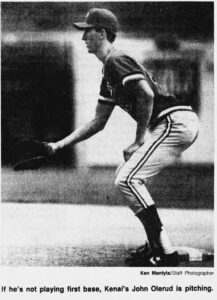
In the Oilers 7 games during the 1988 NBC World Series, Olerud would have at least one hit in each. After a second-round defeat, he homered against the Tulsa (OK) Cubs, as the Oilers began their march through the losers bracket. Up next were the Lawrence Travellers, champions of the NBC Kansas state tournament, seeded 7th overall in the National. Olerud, who played first base when he wasn’t pitching, took the mound that night to stave off elimination and keep the Oilers title hopes alive.
What followed was a performance dubbed ‘arguably, the NBC’s finest game‘. He homered in his first two at-bats and then doubled in his third. On the mound, he was in the process of striking out 7 while scattering 7 hits. The flood gates opened for the Oilers in the 6th and 7th innings, scoring a combined 8 runs as Olerud added a single and his third home run of the night during those frames. All told, he became the 6th player in NBC history to homer 3 times in a game, the 15th to go 5-5, and he established a new tournament record of 15 total bases, while ALSO throwing a complete game (albeit 7 innings due to the tournaments run rule), and getting the win in a 12-3 rout. In one of the few times that fans wished the run rule wasn’t in place, Olerud was guaranteed at least one more at-bat if it didn’t exist.
At the time, Olerud remarked on his extraordinary performance, “I had never had that kind of night. It was my best night ever as a hitter and then to be on the mound made it even more special.”
Olerud continued his hitting streak the following day adding two more home runs and driving in 5 for the second straight game, going 3-3 against the Mobile (AL) All-Stars. The second home run, was his 6th of the tournament which at the time tied him with his teammate Richie Grayum, along with NBC Hall of Famers Whitey Herzog and Von Hayes for most ever in a tournament. Grayum would hit his 7th the following day in an extra inning victory against the Clarinda (IA) A’s, while Olerud cooled off “only” going 2-5. That win placed them in the semifinals where the Oilers were eliminated by the eventual champion Everett (WA) Merchants, but Olerud had left his permanent mark on the NBC. He was named NBC All-American first baseman as the Oilers finished in third place with a 5-2 record.
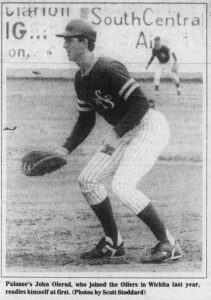
In the winter, prior to his Junior season at WSU, Olerud suffered what turned out to be a brain aneurysm. He successfully underwent a high risk 6-hour surgery, and as a precaution from that point forward, always wore a helmet on a baseball diamond even when he was playing defense, to protect the vulnerable area on his skull. He recovered quickly from the operation, returning to action in April, and hit .359 before the Toronto Blue Jays drafted him in June. Olerud had every intention of playing his Senior year at WSU, and spent the summer with Palouse Empire going 8-1 and hitting well over .300. Both the Oilers and Anchorage Glacier Pilots asked him to play for them in the 1989 NBC but he chose to sit it out and rest, and by the end of August the Blue Jays made him an offer he couldn’t refuse.
“I knew I needed time to recover and rebuild my game. I told everyone I wasn’t going to sign because I wanted to get back into playing shape around people like Bobo Brayton who would allow me to come back at my own speed and wouldn’t rush me. I wanted to prove to everyone I was the same player. Toronto drafted me in June and I wasn’t going to sign. I was playing with Palouse again and over the summer became more and more impressed with the Toronto organization. What finally convinced me was when they offered to bring me up in the middle of a pennant race. So I singed the end of August and they called me up in September.”
Olerud made his Major League debut on September 3rd just six days after signing with Toronto, and recorded the first of his 2,239 career hits, as he singled in his lone at-bat. He was left off the postseason roster that year, but was a key contributor for the Blue Jays back-to-back World Series titles in 1992 and 1993 as their first baseman. In 1993, he won the American League batting title hitting .363, even keeping his average as high as .400 as late as August 2nd. Since Ted Williams hit .406 in 1941, only one other player besides Olerud in either league has ever been at or above .400 at any point in August or later (George Brett – 1980).
Olerud played 17 seasons in the majors as a first baseman and designated hitter but never threw a pitch in the majors, nor did he ever hit 3 home runs in a game. Among the accolades he has received include being a member of the WSU, College Baseball, and Canadian Baseball Halls of Fame as well as the Pac-12 Conference Player of the 20th Century. Since 2010, college baseball also has given out an award annually for the best two-way player in the nation named the “John Olerud Award.”
“The NBC tournament was important for me,” says Olerud. “There were a ton of scouts there and it is a great place to show your ability. It was also important for me to see how I matched up. In addition to top college guys, you really get to see how you do against players who have pitched and hit in pro ball. You find out a lot about your ability in that kind of situation.”
Today, John and his wife Kelly run the Jordan Fund which they founded in 2003 to support children with disabilities and their families after their daughter Jordan was born with a rare chromosome disorder in 2000. She sadly passed at the age of 19, but her legacy lives on through the foundation.
Olerud’s 1988 NBC World Series stats – 7 games – .483 (14-29), 6HR, 2B, 10R, 13RBI